
Could wireless power reception enable IoT sensors without battery replacement?
AP4420 converts small amounts of RF power into usable power for sensors.
It supports IoT sensing without the constraints of battery replacement or power wiring.
AP4420 at CEATEC 2026
Are power supply and battery replacement becoming barriers to deploying IoT sensors?
In logistics warehouses and factories, the number of IoT sensors being deployed is increasing for environmental monitoring, such as temperature and humidity, equipment condition monitoring, and location and asset management. At the same time, installing power wiring for sensors and regularly replacing and managing numerous primary batteries can create a significant burden when expanding the scope of deployment. Wiring installation and battery replacement can be particularly difficult when sensors are retrofitted to existing equipment or installed on moving parts, in high places, or in confined spaces. The use of over-the-air wireless power transfer is attracting attention as one possible approach to these challenges.
Reducing power supply constraints to make IoT sensors easier to install and use
Wireless Power Transfer (WPT) is a technology that transmits power over radio waves from a transmitter installed at a separate location to a compatible receiving device. In Japan, regulatory measures for WPT systems operating in the 920 MHz band were introduced in June 2026, covering outdoor use under specified conditions and license-exempt operation subject to output limitations. These changes are expected to broaden the range of applications, including powering sensor devices in factories and warehouses.*1
On the receiving side, the small amount of RF power—which can vary depending on the distance from the transmitter, antenna orientation, obstructions, and reflections—must be efficiently converted into DC power that can be used by the system.
Asahi Kasei Microdevices (AKM) is developing the AP4420, a receiver-side power management IC designed to address these challenges and deliver small amounts of wireless power to IoT devices.
*1 This explanation is based on the revision of Japan’s Rules for Enforcement of the Radio Act and related regulatory measures promulgated on June 23, 2026. The regulatory information in this section applies to WPT systems operated in Japan. When using a WPT system, please confirm the laws, regulations, and technical standards applicable in the relevant country or region.

AP4420: AKM’s receiver-side solution for efficiently utilizing small amounts of wireless power
The AP4420 is a receiver-side power management IC that converts small amounts of RF power received from a transmitter into DC power that can be used by IoT devices.
Combining RF rectification and power management technologies for low-power applications, the AP4420 supports the design of sensors, microcontrollers (MCUs), Bluetooth® Low Energy devices, and other IoT devices designed for wireless power transfer.
The AP4420 integrates a CMOS rectifier suitable for operation in the 920 MHz band, a boost DC-DC converter, and energy storage and power supply control functions. By modifying the receiving antenna, matching circuit, and other components, the AP4420 can also support designs for different frequency bands, such as the 915 MHz band in North America and the 868 MHz band in Europe.
* Bluetooth® is a registered trademark of Bluetooth SIG, Inc.
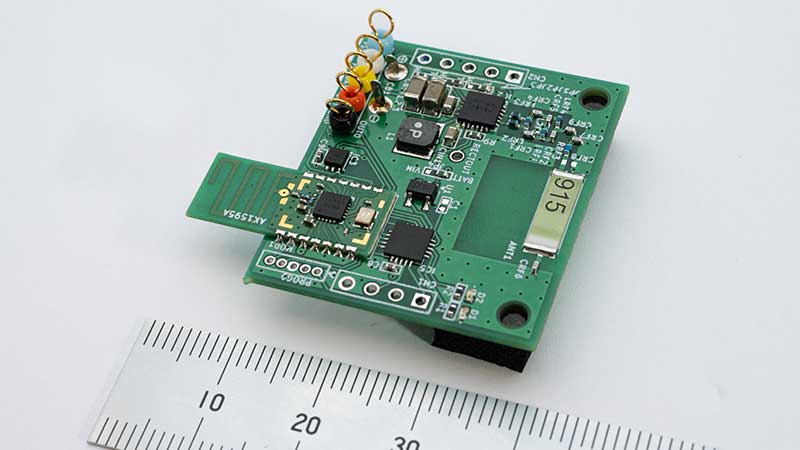 AP4420 Evaluation Module (Under Development)
Applications
Environmental and condition sensing in logistics warehouses

Wireless power can be supplied to multiple sensors that detect temperature and humidity, door open/close status, occupancy, and other conditions in warehouses. When combined with wireless communication technologies such as Bluetooth® Low Energy, the AP4420 can contribute to reducing the need for power wiring and enabling sensors to operate without primary batteries.
Adding sensors to existing factory automation and logistics equipment

Wireless power transfer supports the installation of sensors on moving parts, in high places, and in confined spaces where wiring installation and maintenance can be difficult, as well as the retrofitting of existing equipment. In addition, the receiver-side circuit can be designed in a compact form, making it easier to integrate into space-constrained applications.
Beacon-based tracking and management of assets in warehouses

When combined with a low-power Bluetooth® Low Energy transmission IC such as the AK1595B, the AP4420 supports tag designs that do not use primary batteries, helping reduce the burden of battery replacement and management when operating numerous beacons and tags.
For product or sample requests, technical questions, or requests for product information, please complete and submit the request form below.
Please note that we may contact you from our affiliated companies and representatives/distributors for appropriate response.
Depending on the content of technical questions, it may take some time to answer.
Please note that technical inquiries from free e-mail addresses may not be answered.
Note
・Please read our Terms and Conditions, Privacy Policy, and Cookie Policy before using this service.
・By submitting these forms, you agree to AKM’s Terms and Conditions, Privacy Policy, and Cookie Policy.
myAKM service
You can receive the latest product information and notifications of new and updated documents, news, topics, events and exhibitions by e-mail. We may also send you exhibition invitations or contact you by phone. Please refer to myAKM membership service for further details.

Copyright © Asahi Kasei Microdevices Corporation. All rights reserved.