





-
Products

-
Applications
-
Support
-
About AKM


Enables Angle Detection at High Rotational Speeds, a Challenge for Optical Encoders
SMRE technology enables both high-speed rotation and high accuracy: a challenging combination for optical encoders.
Semiconductor Magnetoresistive Elements
Trends in the Machine Tool Market
Increasing Rotational Speeds to Reduce Machining Time
In recent years, spindle motors and other components used in machine tools have been required to operate at increasingly higher speeds. This trend is driven in part by the need to improve productivity.
Design Considerations for Optical Encoders
In optical encoders, the response bandwidth of the photodiode and receiver amplifier can limit the maximum rotational speed.
At high rotational speeds, temperature-induced changes in LED light output and receiver-circuit offset can affect angle-detection accuracy, making it difficult to achieve both high speed and high accuracy.

AKM’s Magnetic Encoder Solution Using SMRE
Magnetic Sensing Eliminates the Need for a Photodetector and LED
As described above, the response speeds of the photodiode and receiver amplifier are among the factors that determine the performance of optical encoders at high rotational speeds.
AKM’s magnetic encoder solution uses neither photodiodes nor receiver amplifiers, so it is not subject to these response-speed limitations. This enables operation at speeds exceeding 30,000 rpm.
In addition, SMREs exhibit minimal temperature-induced output variation, enabling stable angle detection even as temperatures rise during high-speed rotation.
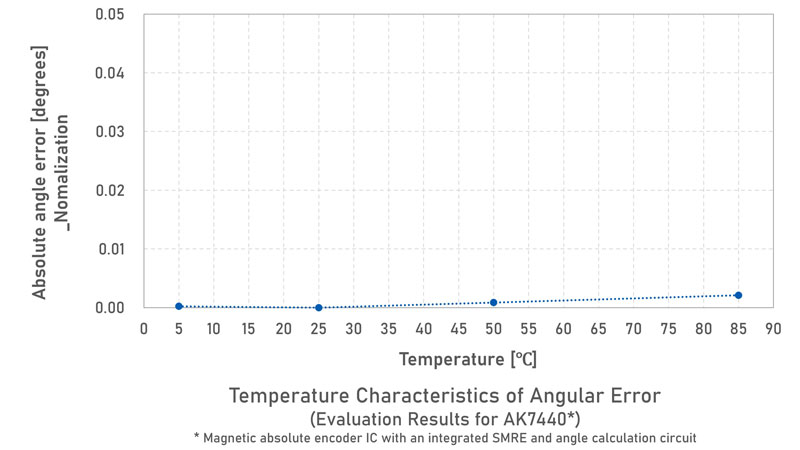
This is due to the excellent temperature characteristics of the SMRE itself.
AKM’s magnetic encoder solution combines high-speed rotational performance with excellent temperature characteristics, enabling highly accurate angle detection under a wide range of operating conditions.
Achieving Both High-Speed Rotation and High Accuracy: a Challenge for Optical Encoders
Because AKM’s encoder solution is magnetic, it does not require a photodetector or LED. This makes it possible to achieve both high-speed rotation and high accuracy without being limited by the response of the optical receiver system or LED light output at high rotational speeds.
It also addresses the effects of magnetic hysteresis and S/N ratio, which have been challenges for conventional magnetic encoders, enabling angle detection with accuracy and resolution comparable to optical encoders.
In addition, the magnetic design is less susceptible to oil, water, and dust, helping simplify protective structures.
For details, see “High Accuracy and Resolution Comparable to Optical Encoders” and “Reduced Encoder Costs.”