





-
Products

-
Applications
-
Support
-
About AKM


High Accuracy and Resolution Comparable to Optical Encoders
SMRE technology significantly addresses magnetic hysteresis and S/N ratio issues in conventional magnetic encoders, enabling highly accurate, high-resolution angle detection.
Semiconductor Magnetoresistive Elements
Challenges with Conventional Magnetic Encoders
Conventional magnetic encoders detect rotational angle using a magnetic sensor in combination with a permanent magnet. The magnetic sensor typically uses a magnetoresistive element or a Hall element.
When the permanent magnet mounted on the rotating part turns, the direction of the magnetic field detected by the sensor also changes. The motor shaft’s rotational position and speed are determined from this change. For details, see “#05 Principle and advantages of magnetic encoder.”
This type of configuration can present the following design challenges.
- Angular accuracy: In many cases, the angular error exceeds ±0.1°
- Resolution: Typically 17 bits or less
The angular accuracy and resolution of magnetic encoders depend greatly on the characteristics of the sensor element itself, including the magnetic sensor’s hysteresis and S/N ratio.
For example, the effects of magnetic hysteresis in magnetoresistive elements directly contribute to angular error. Hall elements have low magnetic detection sensitivity, which degrades the S/N ratio of the detected signal.
These challenges have made it difficult for conventional magnetic encoders to achieve accuracy and resolution comparable to optical encoders.

AKM’s Magnetic Encoder Solution Using SMRE

- Angular accuracy: Achieves ±0.001° (±3 arcsec)
- Resolution: Up to 25 bits
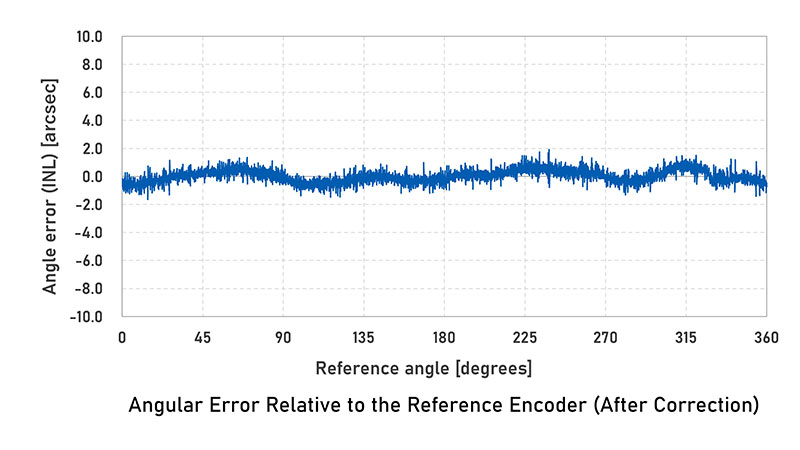
To improve the accuracy and resolution of magnetic encoders, it is important to reduce the effects of magnetic hysteresis and improve the magnetic sensor’s S/N ratio.
SMRE has a hysteresis-free structure, so magnetic hysteresis does not affect angular error. It also offers higher magnetic detection sensitivity than Hall elements, resulting in a better S/N ratio for the detected signal.
These features make it possible to achieve accuracy and resolution comparable to optical encoders while using magnetic sensing.
Achieving High Accuracy and Resolution Comparable to Optical Encoders
As described above, AKM uses SMRE technology in its magnetic sensors to address the effects of magnetic hysteresis and S/N ratio—challenges faced by conventional magnetic encoders. This enables AKM to provide a solution with accuracy and resolution comparable to optical encoders.
The solution also enables stable angle detection at high rotational speeds compared with optical encoders. In addition, the resistance of magnetic sensing to oil, water, and dust helps reduce the need for protective measures.
For details, see “Enables angle detection at high rotational speeds, a challenge for optical encoders” and “Reduced Encoder Costs.”