





-
Products

-
Applications
-
Support
-
About AKM


Indoor Air Quality (IAQ) by CO2 Monitoring
Air quality can be controlled by measuring CO2 levels.
This saves energy while maintaining a healthy indoor environment.
CO2 Sensors
We spend much of our daily lives indoors such as in rooms, classrooms, offices, and stores. As more people gather, CO₂ concentration rises, and air quality deteriorates in poorly ventilated environments. This affects not only health but also the ability for concentration, productivity, and even decision-making performance. For these reasons, proper ventilation is essential for maintaining indoor air quality.
On the other hand, excessive ventilation increases HVAC energy consumption and raises operating costs. It is therefore important to keep a proper balance among the issues of comfort, health, and energy efficiency.
For this reason, an approach that measures indoor CO₂ concentration as an indicator of air quality and controls HVAC and ventilation systems accordingly is attracting attention.
What happens to us if we do not use ventilation?
Guidelines for indoor air quality and CO2 concentration standards have been established around the world.
For example, in Japan, the Ministry of Health, Labor and Welfare's health management standards for buildings stipulate that CO2 concentrations should be kept below 1000 ppm. When this concentration is exceeded, it causes discomfort. If the concentration rises further still, it will cause blood oxygen levels to fall, causing various physical issues such as drowsiness, headaches, and fatigue. It also causes declines in work and study productivity. High CO2 levels also affect sleep.
The following studies have been published on the effects of CO2 on the human body.
Low indoor CO2 concentrations of 500 to 800ppm are considered to harmless. However, as CO2 levels rise, they cause drowsiness and affect cognitive abilities, such as impairing learning and decision-making ability. At levels of 80,000 ppm or higher, people lose consciousness and eventually die.

Studies regarding decision-making ability
CO2 concentrations of 1500ppm to 3000ppm have been observed to negatively affect human performance and health.
#1 1500 ppm and above: Scores worsened in tests of decision-making ability
#2 2500 ppm and above: Test passing rates fell
#3 2500 ppm and above: Scores declined in tests measuring decision-making ability
#4 3000 ppm and above: Changes in specific frequency components of cardiac cycle variations correlated with autonomic nerve balance
(#1 Harvard T.H. Chan School of Public Health, January 2016)
(#2 Harvard T.H. Chan School of Public Health, January 2018)
(#3 State University of New York, December 2012)
(#4 Budapest University of Technology and Economics, March 2012)
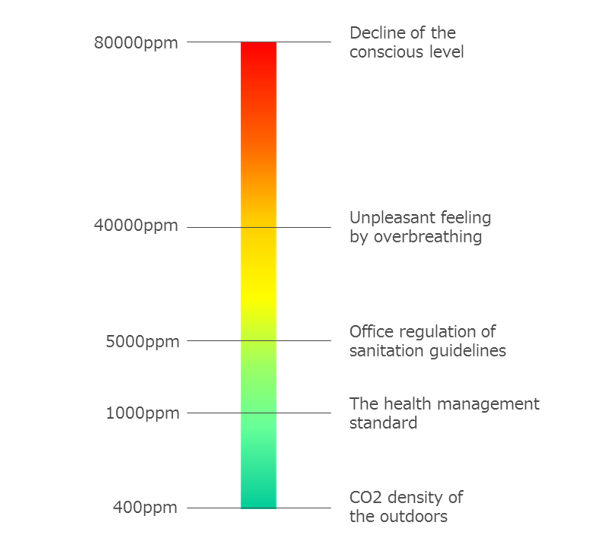 Relationship between CO2 concentration and activity
Studies regarding the relationship between CO2 concentration and drowsiness/sleep
Studies show that drowsiness increases at CO2 concentrations of 2500ppm and above and sleep quality decreases at concentrations of 1500ppm and above.
#1 1500 ppm and above: Decreased subjective sleep efficiency
#2 1700 ppm and above: Decreased subjective sleep quality
#3 2500 ppm and above: Increased subjective drowsiness
#4 2700 ppm and above: EEG showing increase in brainwaves indicating drowsiness
#5 3,500 ppm: Increased subjective drowsiness *Verified through actual vehicle driving
(#1 Waseda University, September 2018)
(#2 Technical University of Denmark, October 2014)
(#3 Tampere University of Technology, January 2016)
(#4 University of Southampton, November 2018)
(#5 Taipei Medical University, January 2020)
 Air quality and conserving energy in the office
The main source of CO2 inside buildings is the exhalation of the people inside them. Typically, CO2 concentrations range from 400 to 2,500 ppm. The greater the number of people, the greater the CO2 concentration. Opening windows is, of course, important, but it is also recommended to use ventilation control systems.
CO2 sensors measure the amount of CO2 in the air and send a signal to a ventilation device or variable air volume system (VAV). They then control individual fan damper valves to adjust ventilation levels. Of course, air is not composed of CO2 alone. Ventilating rooms also reduces the number of viruses and bacteria, improved indoor air quality.
In Europe, the EU’s Energy Performance of Buildings Directive (EPBD) requires all new buildings built after 2020 to meet the “Nearly Zero Energy Building (nZEB)” standard, and the adoption of the Zero Emission-Building (ZEB) standard is also progressing.
In the United States also, the Federal Government has announced a definition for Zero-Emission Building, strengthening the policies toward achieving decarbonization. Additionally, many States, including California, are expanding programs that promote Zero Net Energy (ZNE) buildings, with government and private markets working together to promote adoption.
In Japan, the Act on the Improvement of Energy Consumption Performance of Buildings has gradually made compliance with insulation performance and primary energy consumption standards mandatory for new houses and buildings, leading to increased airtightness and thermal insulation.
While global trends are improving the residential energy efficiency, the increased airtightness raises concerns about insufficient ventilation, rising indoor CO2 concentrations, and deteriorating air quality. Therefore, alongside improved insulation, the importance of ventilation control using CO2 sensors is increasing.
In terms of managing ventilation, heating and cooling demands vary by season, and the number of people visiting commercial buildings such as offices, classrooms, and cinemas also changes significantly from day to day. If ventilation is based on the maximum occupancy, energy is wasted when rooms are unoccupied. By using CO2 sensors effectively, it becomes possible to estimate the required amount of air for each room based on the actual conditions and control ventilation accordingly.
At Asahi Kasei Microdevices (AKM), verification experiments conducted in actual restaurants and homes confirmed that our CO2 sensors are effective in assessing and improving air quality.
How much energy does ventilation use?
Among the 13 countries participating in the International Energy Agency's (IEA) energy-saving program for buildings and regional systems, the total primary energy consumed by building ventilation was estimated to be equivalent to 9% of each country's total primary energy consumption.
Each year, an estimated 3 exa-joules (EJ: 10^18 joules) of energy are used in the ventilation of US homes. This accounts for roughly 30% of the total energy used by these buildings. In the U.S. service industry (buildings such as commercial facilities, agencies, and government agencies), an estimated 1.5 EJ is used for ventilation. This accounts for roughly one-quarter of the total energy consumed by buildings in the service industry. In addition, ventilation accounts for approximately 1,000 tons of carbon dioxide emissions each year in the U.S. housing sector and 800 million tons each year in the service sector.
The energy required to regulate ventilation temperatures is greatly affected by the climate. In Europe, most of ventilation temperature control energy is used for heating. In the United States, considerable energy is used for both heating and cooling. In the humid Miami climate, 86% of this energy is used to dehumidify ventilation air. It is vital to consider how these energy expenditures can be reduced in order to protect the global environment.
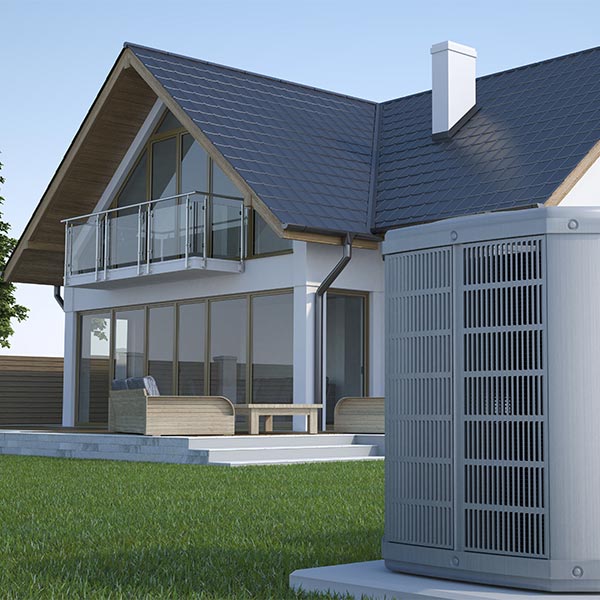
Where should sensors be placed in rooms?

The locations where CO2 measurement sensors should be installed depend on the size of the room. In large areas such as restaurants and lobbies, it is logical to install them in ventilation systems to detect the CO2 levels of exhaust. If a sensor is installed on one wall, it could lead to incorrect assumptions about the CO2 levels on the opposite side of the room. In a typically sized room, the use of a wall-mounted sensor is sufficient.
CO2 level and temperature distributions differ. Temperatures are uniform throughout rooms. CO2 concentrations, on the other hand, can vary from 3,000 ppm on one side a room to 600 ppm on the other side.
Be careful regarding CO2 concentration when using air purifiers, as well.
In indoor environments where all windows and doors are closed, CO2 concentrations may still rise even if an air purifier removes contaminants. Some air purifier manufacturers inform users about this characteristic.
To maintain a comfortable and healthy indoor environment, using a CO2 sensor is effective in addition to an air purifier.
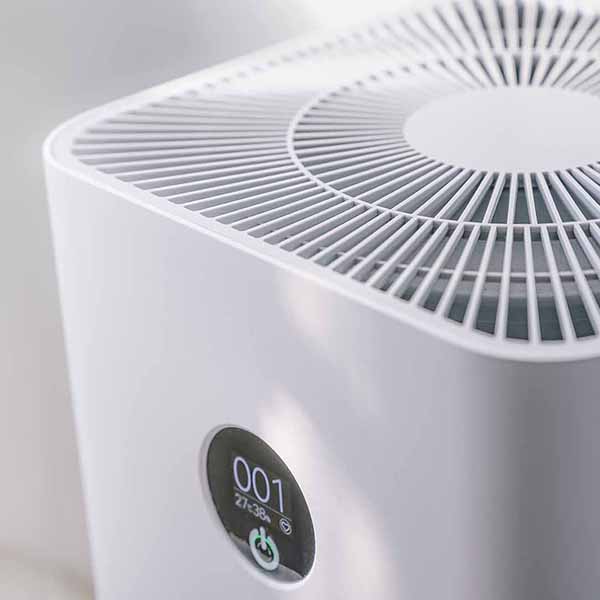
Examples of CO2 sensors used to measure indoor air quality

As interest in air quality grows, many manufacturers are offering devices capable of accurately measuring indoor CO2 concentration.
Here are some examples of products equipped with our sensors.