




-
Products

-
Applications
-
Support
-
About AKM


Industrial Robots / AC Servo
Current Sensors
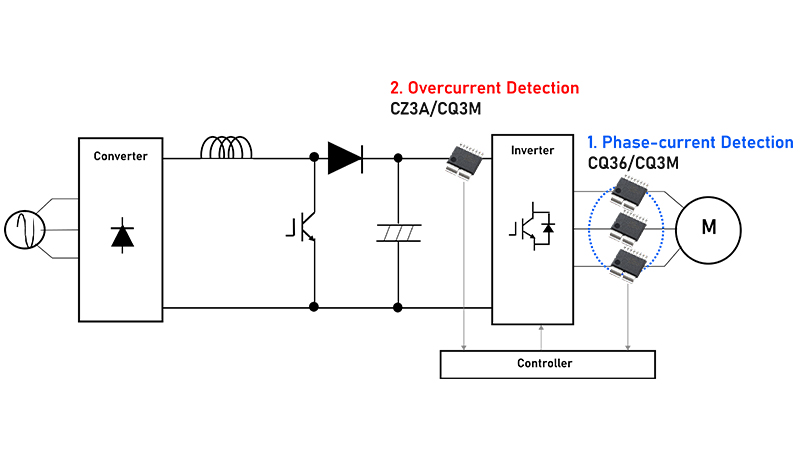
Current sensing in industrial robots, collaborative robots, CNC machine tools, and AC servo systems is mainly used for two purposes:
1. Vector control (phase-current sensing)
2. Protection (overcurrent detection)
Miniaturization Challenges Caused by Heat generation from Shunt Resistors
Shunt resistors (cement resistors in high-capacity models) are widely used for phase-current sensing and overcurrent detection in industrial AC servo systems and robots. With this method, current is measured based on the voltage drop across the shunt resistor. The resistance value is selected based on the current range to be measured and the required measurement accuracy and signal-to-noise ratio (S/N).
Heat generated by a shunt resistor increases in proportion to its resistance, making it a significant challenge, particularly in systems that handle high currents. To keep the temperature rise within the rated limits, thermal design measures are needed, such as increasing the heat-dissipation area on the circuit board or adding cooling components such as fans and heat sinks. As a result, the circuit PCB board becomes larger, making it difficult to miniaturize the overall system.
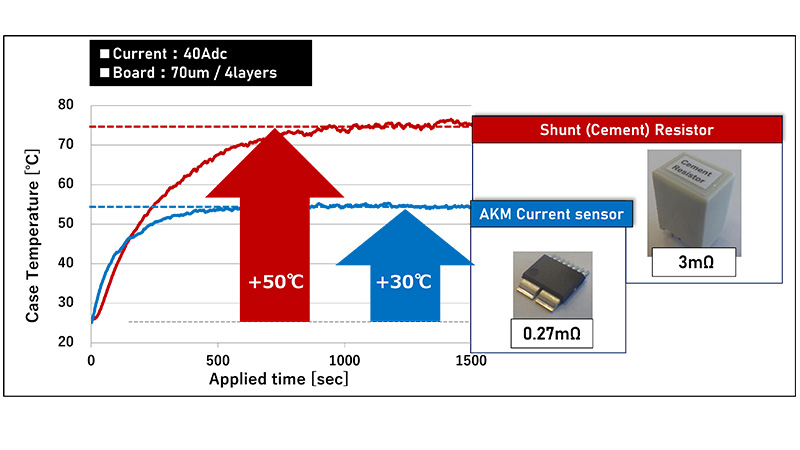
For example, consider an 8 kW, 200 V system with an RMS current of 40 Arms. If the shunt resistance is selected at approximately 3 mΩ based on the ADC input range and peak current, the power dissipation (I²R) is approximately 4.8 W at an RMS current of current 40 Arms. Even when sufficient heat-dissipation area is provided on the circuit board to spread this heat, the shunt resistor temperature rise can reach approximately 50°C.
Reducing Heat Generation with a Low-Resistance Current Sensor
Asahi Kasei Microdevices Corporation (AKM) current sensors help address this issue. With a very low primary conductor resistance of 0.27 mΩ, they significantly reduce heat generation compared with shunt resistors. This makes it possible to reduce the heat-dissipation area and the number of cooling components, such as heat sinks, helping significantly reduce PCB area and miniaturize the overall system.
Under the same conditions as above, the temperature of the current sensor rose by only about 30°C, even though the evaluation board had almost no dedicated heat-dissipation area compared with the board using a shunt resistor.
Further System Miniaturization by Reducing the Number of Components
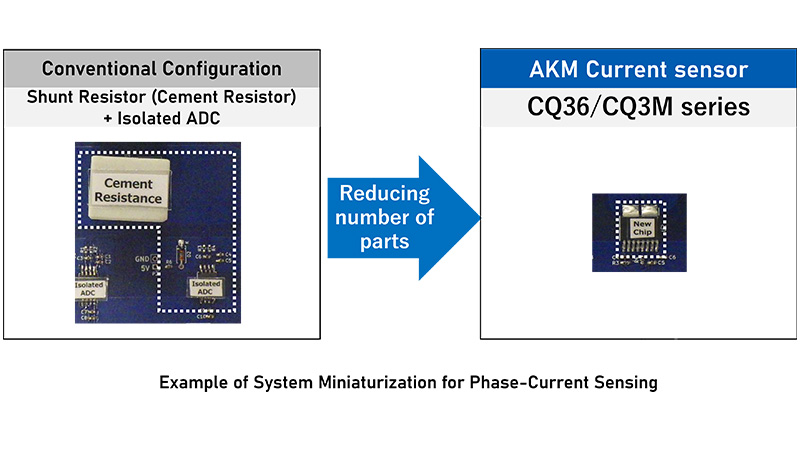
Phase-current sensing commonly uses a shunt resistor and a ΣΔ isolated ADC. This configuration requires not only a shunt resistor but also a filter circuit for noise suppression and an isolated power supply for the ADC, increasing the number of components and the required PCB area.
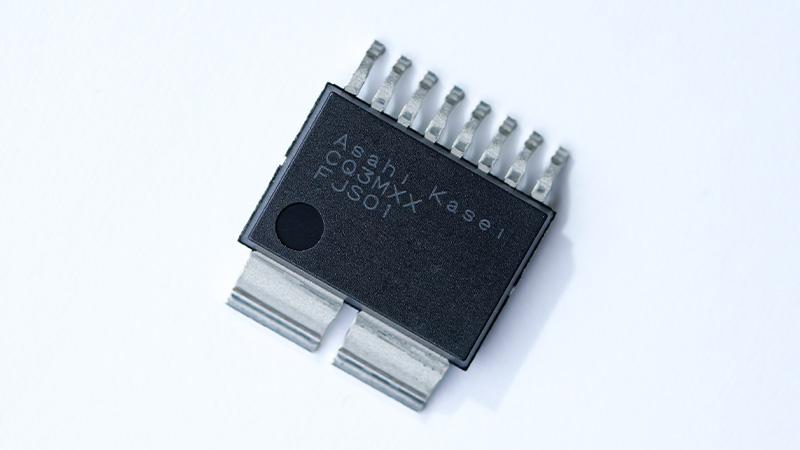
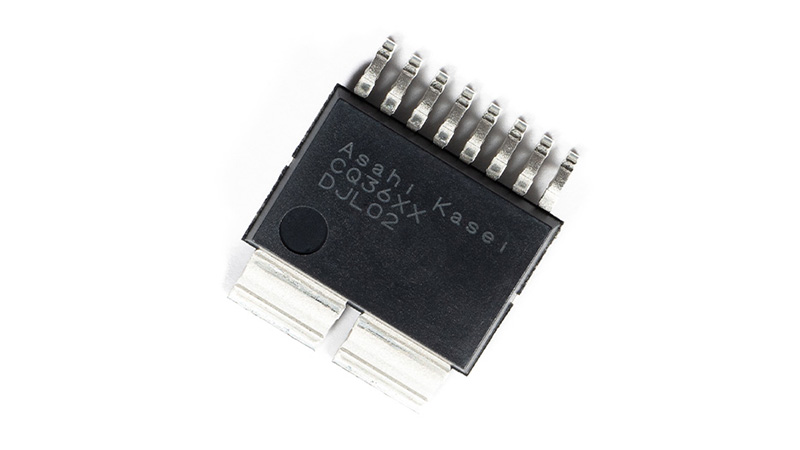
In contrast, AKM’s CQ3M series and CQ36 series current sensors integrate a low-resistance current conductor, a ΣΔ modulator, and galvanic isolation. They can therefore replace the conventional shunt resistor + isolated ADC configuration with a single current sensor, reducing the number of components and PCB size.
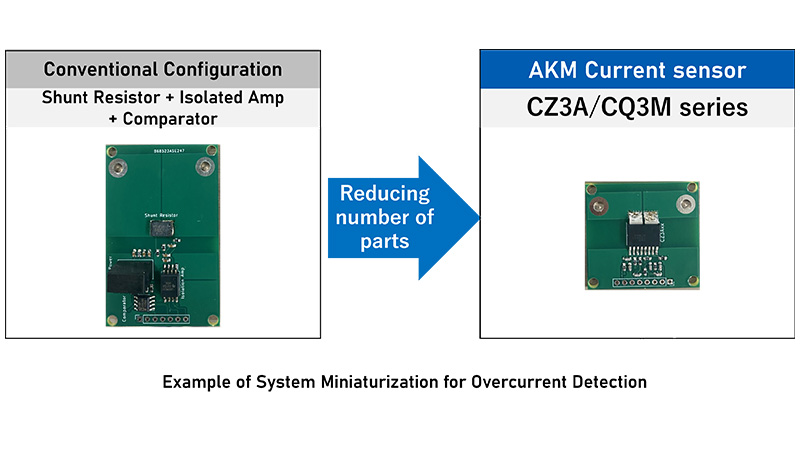
For overcurrent detection, a common configuration combines a shunt resistor with an isolated amplifier and a comparator. This configuration requires a filter circuit for noise suppression, an isolated power supply for the amplifier, a threshold-setting circuit, and a filter circuit to adjust response time, making the circuit more complex.
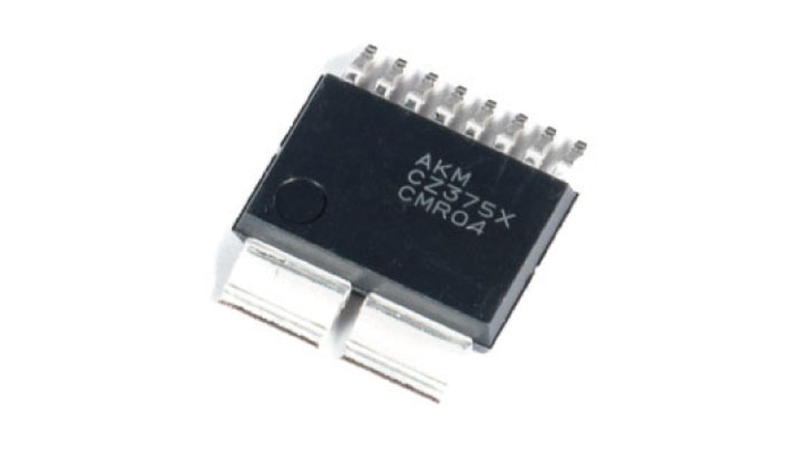
By contrast, AKM’s CQ3M series and CZ3A series current sensors integrate a low-resistance current conductor, a comparator with an adjustable threshold, and galvanic isolation. This allows the conventional shunt-resistor-based configuration to be replaced with a single current sensor. The CQ3M series also allows the response time for overcurrent detection to be adjusted, enabling protection designs optimized for each application. The CZ3A series includes two independent overcurrent detection circuits, supporting a wide range of applications, including protection functions with different thresholds and response times.
In addition, the CQ3M series provides high-accuracy current sensing through its ΣΔ output, while the CZ3A series provides current sensing through its analog output. Both series can perform current sensing and overcurrent protection at the same time, making them suitable not only for motor control but also for power monitoring applications.
Please refer to the AKM’s recommended devices for your application.